Monday, August 29

Recent Reads {Miniatures and Morals}

This post may contain affiliate links.
 

Miniatures and Morals - the Christian novels of Jane Austen by Peter J Leithart - Several years ago a friend recommended a book by Peter Leithart, a literary study of the Old Testament.  I purchased it, read it, and loved it, and have been a Leithart fan ever since.  I have a couple other books of his, and the ones I don't own are on my wish lists.  Near the beginning of this year, a fellow blogger mentioned challenging herself to read all of Jane Austen's works in 2011, using Leithart's Miniatures and Morals as her study guide.  I decided to take the same challenge, purchased the book and started in.  Yesterday I finished the final Austen novel on the list (Persuasion) and also the final chapter of Leithart's insightful commentary and analysis.  Leithart is a Senior Fellow of Literature and Theology at New Saint Andrews College, and his study of the characters and themes in Austen's novels focuses on her 'miniaturist' style and her interest in Christian virtues.  While the novels are never 'preachy' it is clear that godly virtues such as patience, self-control, charity, honesty, and integrity are held in high esteem by Austen and her noble characters.  Leithart brings these to the fore, showing how Austen highlights the virtues and contrasts the characters that display them with the characters that are lacking, often using irony and wit to do so.  The book opens with a chapter entitled Real Men Read Austen (how can you not love a book with that chapter title!?), in which he extols Austen as a master of intelligent humor and a writer with incredible insight into human behavior; and challenges the notion that Austen's novels are only for women.  He admits that much of the action does take place in quiet domestic settings such as drawing rooms and formal gardens, but asserts that she creates strong male characters who may be considered Christlike lovers in that they are willing to sacrifice for their brides and are servant-heroes.  Leithart also suggests that men can learn much about romance from a woman's point of view by reading Austen, and that she is a leading commentator on ethics, morality, culture, and public theology.  Worth reading, indeed!  From there, he analyzes each of Austen's novels in turn, beginning with Pride and Prejudice, showing how each focuses on a set of manners, moral guidelines and attitudes.  The commentaries include review and thought questions, so this book can be used for the casual reader to enhance their understanding and enjoyment of Austen's work; as well as for the scholar who wants to delve deeper into the literary and theological themes.  I am confident this book could be used as part of a Literature course for high schoolers, and to that end, I do intend to use it in that way for my daughter when she reaches high school age.  She already is enjoying the BBC mini-series adaptations of several Austen novels with me, so I have reason to believe she will thoroughly enjoy reading them herself when she is a few years older.  I highly recommend this book to all Jane Austen fans!
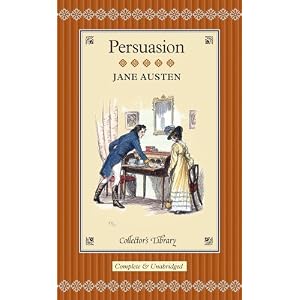
 

Recent Reads {Persuasion}


Persuasion by Jane Austen - Although Pride and Prejudice remains my favorite Austen novel, it's hard to say whether Persuasion or Sense and Sensibility would earn second place.  A very close second place too!  Austen begins this love story when Anne Elliott is getting very close to 30 years old, and her family is facing the prospect of moving out of their ancestral home because of their reduced financial situation.  Anne and her older sister are spinsters and their marriage prospects are dwindling.  Her father, Sir Walter, is vain and self-absorbed, and his preoccupation with acting the fine gentleman and giving every appearance of being wealthy and socially important has led him to spend more than he ought.  Instead of taking Anne's counsel to simply cut back on their style of living, the Elliotts choose instead to lease out their home so they can continue to pretend to wealth and consequence in the resort town of Bath.  As it turns out, the property is leased to a couple related to Captain Frederick Wentworth, with whom Anne had had a relationship some seven or eight years prior.  At that time, Anne had been persuaded to break off the engagement because of her family's objections to Wentworth's inferior connections and fortune.  With all of that background, clearly the reunion between Anne and Wentworth will be awkward and uncomfortable, and while we know that Anne is still deeply in love with Wentworth, we don't know what his feelings are.  Anne herself must rely on studying his expressions and actions, and on snippets of conversation to deduce what his attitude towards her may be, as propriety doesn't allow her to open the subject or even have a private conversation with him.   The story follows all the circumstances surrounding their meeting again and all the situations in which they are thrown together in the company of the many other characters, and the growing conviction Anne has that he still cares for her.  I found this a delightful love story, and the supporting cast of characters provides ironic humour and insightful glimpses into behavior, manners, and relationships.

By the same author:  Emma, Pride and Prejudice, Northanger Abbey, Sense and Sensibility, The History of England, Mansfield Park

Thursday, August 25

Recent Reads {Maire}


Maire by Linda Windsor - some time ago I was introduced to author Linda Windsor after picking up a book from the library feature shelf.   Her historical novels are really intriguing me!  This one is the first in a trilogy called The Fires of Gleannmara, and is set in fifth-century Ireland.  Maire is the young warrior queen of Glennmara who meets Rowan of Emrys when her warband attacks his settlement in Wales.  Maire takes Rowan as her hostage and husband, in order to secure tribute from his settlement and to save herself from an arranged marriage to a druid she doesn't trust.  She doesn't understand Rowan's faith or dedication to the one God, but finds that she can trust Rowan's courage and wisdom, and eventually comes to faith in the one God herself.  Windsor sets her fictional characters into an historical Ireland that brings the early days of Christianity in Erin to life.  A very enjoyable story!

By the same author:  Healer, Thief

Tuesday, August 23

Recent Reads {Deep Church}


Deep Church by Jim Belcher - It took me a very long time to read this book, partly because it's very meaty and full of information and 'thought-provokers' that I wanted to turn over in my mind for awhile before reading further.  And partly because I took lots of breaks from reading it.  8-D  Belcher, a church planter and lead pastor of Redeemer Presbyterian Church in California, has background in both the traditional or mainstream church and the beginnings of the emerging church movement, so he is well-qualified to discuss the merits and criticisms of both sides in this debate.  He begins the book by giving some of his own background and experience, and by carefully defining for the reader what he is referring to in using the terms "traditional" and "emerging".  Just as there are many denominations and a broad spectrum of church personalities that would fall in the traditional/mainstream church category, there is a broader range of styles and approaches within the group generally referred to as the "emergent" or "emerging" church than many of their critics may recognize.  He also discusses how the movement began and how it is influenced by post-modernism, while much of the traditional church is still influenced by Enlightenment rationalism. After establishing the groundwork, Belcher goes on to explore the seven main protests that the emergent movement (in general) brings against the traditional church.  In each case, Belcher discusses the issue, the criticism the emergent church has of the traditional church, the criticism the traditional church has of the emergent, the defenses of each, and the validity of these arguments.  Then the chapter dealing with that issue ends with a discussion of how the "deep church" (a term coined by C.S. Lewis) may be able to forge a third way, providing "constructive models of what this alternate, dep church looks like - a missional church committed to both tradition and culture, valuing innovation in worship, arts and community but also creeds and confessions." (from the book cover)  Most of these suggestions for the third way have been tried and proven by Belcher's own Redeemer Presbyterian or other churches.

I found the entire book very informative and thorough in presenting both viewpoints, and fair in offering defense and criticisms.  It gave me a bit of pause in reading the endorsements appeared to be from leaders associated with the emergent church, and I wondered why I didn't see endorsements coming from traditional church leaders.  I still don't know why that is the case, but I was satisfied in reading that Belcher was giving equal time and consideration to the concerns raised on both sides of the issues.  While reading his suggestions and experiences in seeking the deep church ideal, I sometimes had to fight the perception that Belcher was in effect saying that HIS church was getting it ALL right, but he really didn't have a haughty demeanor in presenting these thoughts - it was more in the vein of sharing what their church adopted as its mission and goals in these areas and how they were living those ideals out in the real world.  Not everything was a success, certainly not on the first try.

My opinion on the tension between traditional and emergent is generally that both may be valid viewpoints and approaches to doing church, but whenever the church is out of balance there will be a problem.  Reading this book has, for the most part, reinforced and expanded that idea by exploring ways that the church can avoid veering sharply to one side or the other and instead look for ways to go deeper and beyond the extremes.  For example, we shouldn't focus solely on personal righteousness and ignore the responsibility to serve in our communities and impact the world, or vice versa.  The vastness of God's grace and mercy can only be grasped when we also recognize His holiness and the seriousness of sin.  When we cut off our ties to our history and our roots, we become less relevant to our present day.  While the church needs boundaries, we need to keep our focus on the "well" that is Jesus Christ in our center that draws people in, not on the fences that can keep people out.  (I especially appreciated that analogy!)

Recent Reads {Child of the Mist}


Child of the Mist by Kathleen Morgan - Despite my slight disappointment in the previous Morgan novel I read, I did have this one sitting around so I read it last week.  What can I say - I can't stay away from historical fiction set in Scotland.   While still "lustier" than I think is absolutely necessary for this genre, it was toned down compared to As High As the Heavens.  In this first of a trilogy set in the Scottish Highlands of the 1500s, Anne MacGregor is pledged to marry the tanist of a rival clan in order to bring about a truce between the long-standing feud.  Anne and Niall Campbell are both resistant to the marriage for different reasons but are committed to the good of their families and clans, so they try to make the best of it.  The Campbells are suspicious and fearful of Anne, who has been suspected of witchcraft because of her healing; and Niall's position of leadership is threatened by a traitor.  Anne and Niall both face death and fierce opposition while trying to keep peace and order, and while realizing their growing genuine affection for each other.  The story is quite well-crafted, action-packed, and the Christian faith of the characters, especially Anne, is given much more importance in their actions and motivations than in the previous novel.

By the same author:  As High As the Heavens

Monday, August 15

Recent Reads {As High As the Heavens}


As High as the Heavens by Kathleen Morgan - it wasn't that I didn't like this book, but I must say I was disappointed.  Great potential for an intriguing storyline, and the main plot was a great premise, but I thought there were a couple of minor gaps in the subplots.  However, my main disappointment was that I felt that this was basically a cheap bodice-ripper that had been cleaned up a little.  (Just doing a little bit of quick research, it appears that this book was originally on the secular market and then was reworked a little - IMO, not enough - for the Christian romance fiction market. If that's true, it explains a lot.)  You know just by reading the back cover that the two main characters, Heather and Duncan, will fall in love and live happily ever after despite all the circumstances against them.  What I didn't expect was that they would both be so blatantly lusting after each other right from the first meeting, and that the romance would be so driven by their physical desire.  I don't have objections to the story including these aspects of their relationship, but I didn't read enough evidence that each was actually finding themselves loving the other for their mind and character.  The author tells us that's the case, but focuses more on how difficult it was for them to maintain propriety and virtue in the face of so much temptation.

Anyway, the basic storyline is this - supporters of Mary, Queen of Scots, have hatched a plan to help her escape from the castle at Lochleven and need the rough highlander Duncan to impersonate the court favorite that he resembles closely in order to complete the operation.  Duncan's speech and manners need to be refined so that he can fool the castle's keepers, and Heather is sent to tutor him because her father is one of the conspirators.  Not surprisingly, the two fall in love (and lust LOL) and need to overcome obstacles of mistrust between them and the opposition and manipulation of Heather's father following the the completion of the mission to free Queen Mary.

Recent Reads {Surrender the Dawn}


Surrender the Dawn by MaryLu Tyndall - The final book in the Surrender to Destiny series focuses on Cassandra Channing and Luke Heaton, who previously served on Noah Brenin's ship (in Surrender the Heart, the first book).  Heaton has a reputation as a gambler and drunkard, but has hopes of fitting up his ship as a privateer in order to support himself and his younger brother.  Cassandra's father and brothers are gone, leaving her to support her mother and younger sisters.  She wants to invest in a privateer with the last of her family's savings, but no one will accept a woman as an investor.  The two have a passing acquaintance, since Cassandra is close to Noah Brenin's wife Marianne, so they enter into the business agreement together, and the venture is off to a great beginning - and they are both finding themselves attracted to each other.  There is, of course, a suitor for Cassandra who is devious and manipulative, especially when Cassandra is uninterested in him.  He makes trouble for Heaton, and Heaton's second voyage runs to bad luck, and Heaton is left with few options other than deception and betrayal.  The climax of the story is the bombing of Fort McHenry, and naturally there is a happy ending.   Fluffy, far-fetched at times, but nonetheless fairly enjoyable reading.

By the same author:  Surrender the Night, Surrender the Heart, The Falcon and the Sparrow, Charles Towne Belle Series (The Red Siren, The Blue Enchantress, The Raven Saint), The Legacy of the King’s Pirates series (The Redemption, The Reliance, The Restitution)